
Gauge Size Chart
Gauge sizes run backwards — the bigger the gauge number, the thinner the jewellery, wire or sheet — and each industry has its own scale. This printable pack covers the three most-searched gauge systems: body jewellery (ear gauges from 20g to 1 inch), American Wire Gauge (AWG) and sheet metal gauge, with an actual-size sheet of circles for checking jewellery.
- Instant download
- Editable Excel
- Print-ready PDF
- 7-day refund
5 files · PDF, XLSX
Gauge Size Chart Pack
Printable ear gauge chart (20g–1 in), an actual-size gauge sizing sheet, AWG wire and sheet metal gauge charts, and an Excel gauge conversion workbook.
- Ear gauge chart (PDF/XLSX)
- Actual-size sheet (PDF)
- AWG chart (PDF)
- + 2 more
$5.00 USD, one-time 5 files · about $1.00 each
- Instant download
- 7-day refund
- Secure checkout by Stripe
7-day money-back guarantee. Full refund within 7 days of purchase, even after you download.
Free sample: Ear Gauge Size Chart (PDF, 58 KB)
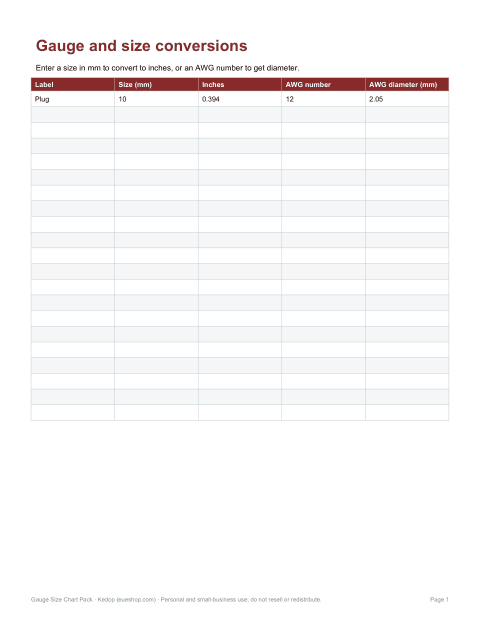
Gauge Size Chart Pack
Printable ear gauge chart (20g–1 in), an actual-size gauge sizing sheet, AWG wire and sheet metal gauge charts, and an Excel gauge conversion workbook.
- Ear gauge chart (PDF/XLSX)
- Actual-size sheet (PDF)
- AWG chart (PDF)
- Sheet metal chart (PDF)
- Conversion workbook (XLSX)
Formats: PDF, XLSX. Instant download after payment (link valid 72 hours, up to 5 downloads). AI-assisted: the templates were drafted with AI help and reviewed and laid out before publishing.
$5.00 USD, one-time 5 files · about $1.00 each
- Instant download
- 7-day refund
- Secure checkout by Stripe
7-day money-back guarantee. Full refund within 7 days of purchase, even after you download.
Free sample: Ear Gauge Size Chart (PDF, 58 KB)
Full refund within 7 days — see the refund policy and license.
Free printables
Single sheets you can print right now, no sign-up. The full pack adds every sheet in one download plus the editable files.
 Printable Ear Gauge Chart
 Printable Gauge Size Chart
 Printable AWG Gauge Size Chart
 Printable Sheet Metal Gauge Chart
 Printable Gauge Size Conversion Chart
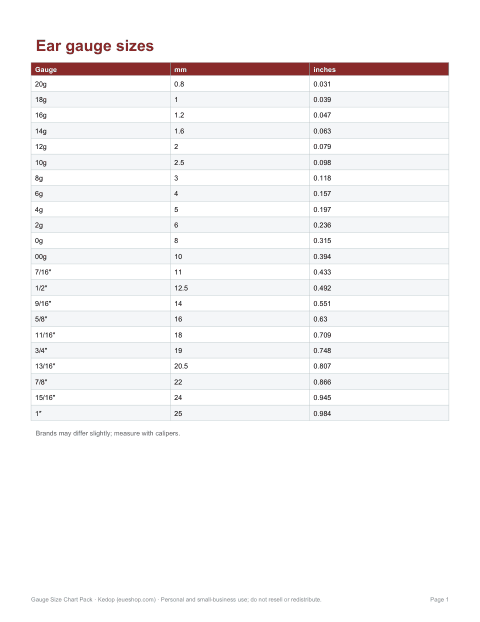
Ear gauge size chart
| Gauge | Millimetres | Inches (approx.) |
|---|---|---|
| 20g | 0.8 mm | 0.031 in |
| 18g | 1.0 mm | 0.039 in |
| 16g | 1.2 mm | 0.047 in |
| 14g | 1.6 mm | 0.063 in |
| 12g | 2.0 mm | 0.079 in |
| 10g | 2.5 mm | 0.098 in |
| 8g | 3.0 mm | 0.118 in |
| 6g | 4.0 mm | 0.157 in |
| 4g | 5.0 mm | 0.197 in |
| 2g | 6.0 mm | 0.236 in |
| 0g | 8.0 mm | 0.315 in |
| 00g | 10.0 mm | 0.394 in |
| 7/16″ | 11.0 mm | 0.433 in |
| 1/2″ | 12.5 mm | 0.492 in |
| 9/16″ | 14.0 mm | 0.551 in |
| 5/8″ | 16.0 mm | 0.630 in |
| 11/16″ | 18.0 mm | 0.709 in |
| 3/4″ | 19.0 mm | 0.748 in |
| 13/16″ | 20.5 mm | 0.807 in |
| 7/8″ | 22.0 mm | 0.866 in |
| 15/16″ | 24.0 mm | 0.945 in |
| 1″ | 25.0 mm | 0.984 in |
Body jewellery gauges below 00g are usually given in fractions of an inch. Some makers list 8g as 3.2 mm and 00g as 9.5 mm; small differences between brands are normal, so measure your jewellery with calipers if in doubt.
Why gauge numbers run backwards
The gauge system comes from wire drawing: wire was pulled through a series of dies, and each pass made it thinner. A higher gauge number meant more passes and therefore thinner wire. Body jewellery borrowed the wire scale for small sizes, and switched to fractions of an inch and millimetres once jewellery grew larger than the old wire gauges.
Standard piercing gauges
| Piercing | Typical starting gauge |
|---|---|
| Earlobe | 20g–18g (studs), often 18g–16g in piercing studios |
| Helix / cartilage | 16g |
| Nostril | 20g–18g |
| Septum | 16g–14g |
| Eyebrow | 16g |
| Lip / labret | 16g–14g |
| Tongue | 14g |
| Navel | 14g |
Your piercer will choose the right gauge for your anatomy and the jewellery used.
Stretching safely
- Move up one size at a time and wait — often at least 4–6 weeks for small sizes and longer as sizes increase.
- Use smooth, single-flare or tapered jewellery made of implant-grade materials.
- Never force a stretch; pain, bleeding or a tight feeling mean stop.
- Keep the area clean and moisturised with a suitable oil.
- Larger stretches (above about 00g) may not shrink back fully.
- See a professional piercer for advice or if you notice irritation.
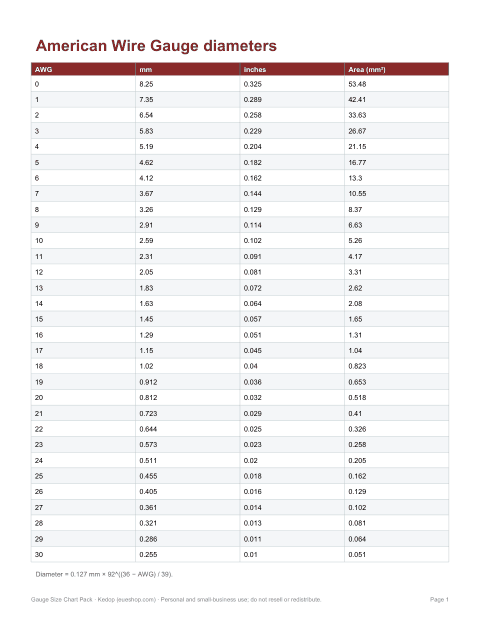
American Wire Gauge (AWG)
| AWG | Diameter (mm) | Diameter (in) | Typical use |
|---|---|---|---|
| 10 | 2.588 | 0.1019 | 30 A circuits, dryers |
| 12 | 2.053 | 0.0808 | 20 A household circuits |
| 14 | 1.628 | 0.0641 | 15 A lighting circuits |
| 16 | 1.291 | 0.0508 | Extension cords, speakers |
| 18 | 1.024 | 0.0403 | Lamp cords, low voltage |
| 20 | 0.812 | 0.0320 | Jewellery wire, electronics |
| 22 | 0.644 | 0.0253 | Breadboard hookup wire |
| 24 | 0.511 | 0.0201 | Network cable conductors |
| 26 | 0.405 | 0.0159 | Fine craft wire |
| 28 | 0.321 | 0.0126 | Beading wire |
AWG diameters follow a formula: each step of 6 gauges roughly halves the diameter. Ampacity depends on insulation, installation and local electrical code — always follow code tables for electrical wiring.
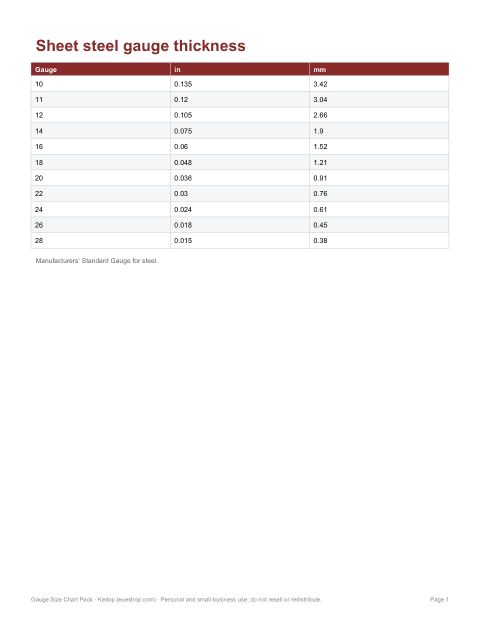
Sheet metal gauge (steel)
| Gauge | Thickness (in) | Thickness (mm) |
|---|---|---|
| 10 | 0.1345 | 3.42 |
| 11 | 0.1196 | 3.04 |
| 12 | 0.1046 | 2.66 |
| 14 | 0.0747 | 1.90 |
| 16 | 0.0598 | 1.52 |
| 18 | 0.0478 | 1.21 |
| 20 | 0.0359 | 0.91 |
| 22 | 0.0299 | 0.76 |
| 24 | 0.0239 | 0.61 |
| 26 | 0.0179 | 0.45 |
| 28 | 0.0149 | 0.38 |
These values are the Manufacturers’ Standard Gauge for sheet steel. Galvanised steel, stainless steel and aluminium use different thicknesses for the same gauge number, so check the material’s own chart.
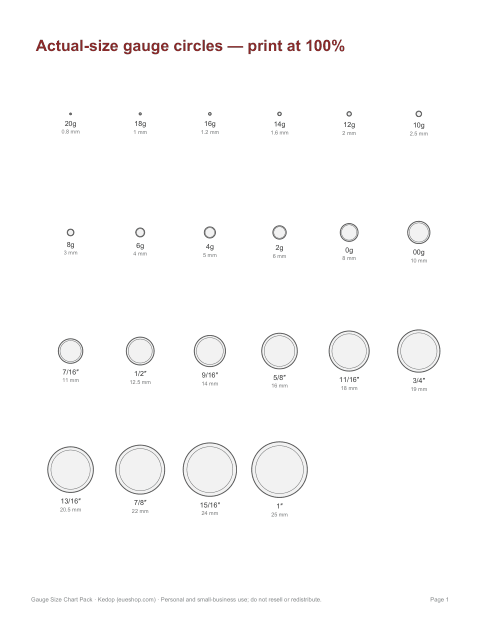
Using the actual-size sheet
- Print the gauge sheet at 100% / “Actual size”.
- Check the printed 25 mm reference line with a ruler.
- Hold a plug, tunnel or taper end over the circles to find the closest size.
- For precise sizing, measure with digital calipers.
Formats
Print-ready PDF charts and an actual-size gauge sheet (US Letter; A4 at 100%), plus an Excel conversion workbook.
Frequently asked questions
What size is 00 gauge in mm?
About 10 mm (some makers list 9.5 mm).
What gauge is a standard earring?
Usually 20g or 18g (0.8–1.0 mm).
Is 14g bigger than 16g?
Yes — lower gauge numbers are thicker.
What is the diameter of 12 AWG wire?
About 2.05 mm (0.081 in).
Was AI used to create the charts?
The charts were generated by script and text drafted with AI assistance, then reviewed before publishing. Confirm critical sizes with calipers or the manufacturer.